Industry 4.0 is the term used to capture a number of trends occuring in the manufacturing sector driven by digitalisation, including automation, increased interconnectivity between cyber and physical systems, and increased management efficiencies provided by big data analytics and cloud computing (Dredge et al., 2018; Smit et al., 2016).
Tourism, which exhibits characteristic of both industry and service sector, is undergoing massive transformation as a result of advances in information technologies and processes of digitalisation.
Technology Development in Tourism
There are three key phases of technology development can be identified in tourism (Dredge et al., 2018).
- Phase 1: Sales and marketing
- 1990-2000: destinations and business able to use Internet as marketing tool, in this way, Websites began to replace paper-based marketing materials.
- Web-based reservation systems started to facilitate business transactions, and distribution systems facilitated increased coordination across the industry.
In 1996, British Tourism Authority launched its new website, visitbritain.com, and plans are made to tailor the site to local markets in the USA, Asia, and Europe.
50 Years Timeline – 1990 to 1999

- Phase 2: Digital business ecosystems
- 2000-2010, the Internet becoming the key source of information for travellers, and it is acting as a virtual marketplace, allows products and services could be searched, compared, and transacted.
- Visitor experience becoming more important than simply provide products by suppliers.
- Customising products and personal connections with customers are key to suppliers.
New business model: innovative online intermediaries, Expedia vs. traditional travel agency
Review sites: TripAdvisor, empower customers as controller of their purchase and as influencer for future consumer
(Dredge et al., 2018)
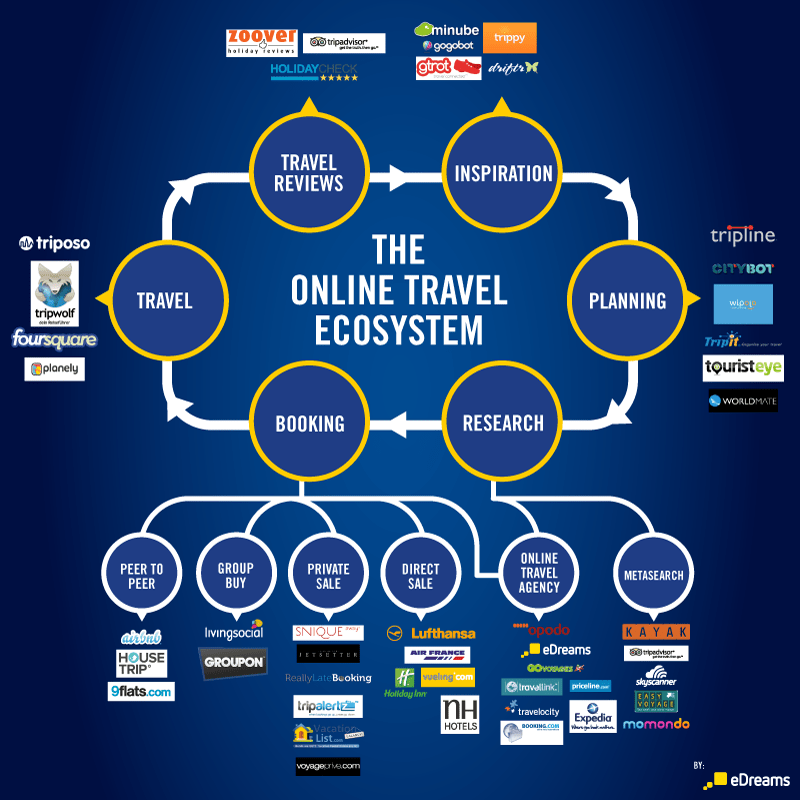
- Phase 3: Integration of systems
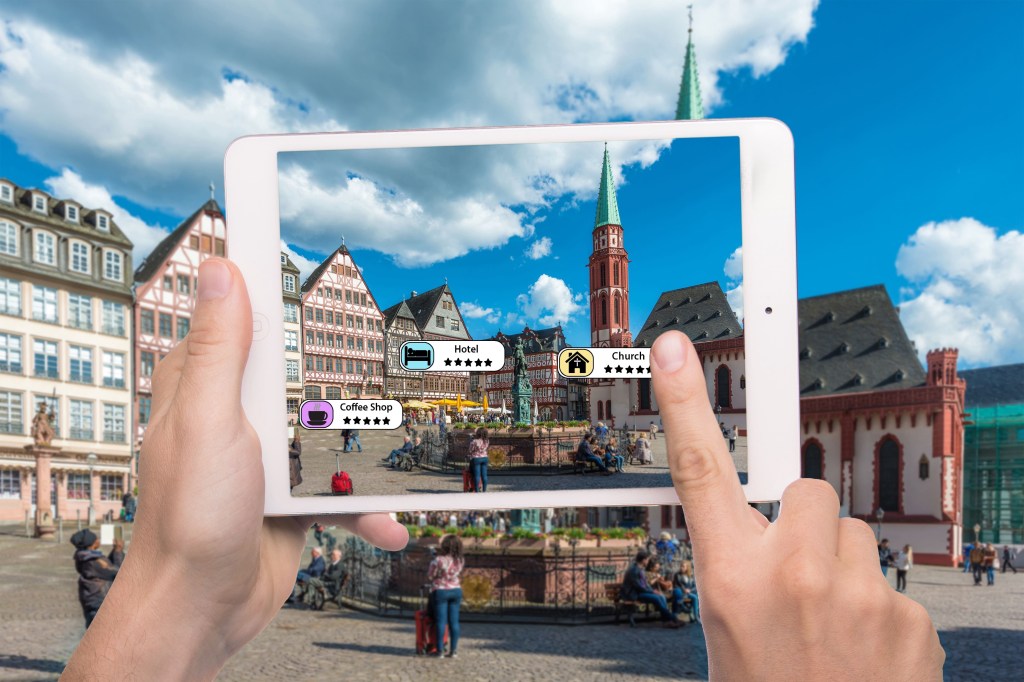
- 2010- , advances such as cloud computing, mobile and wearable technologies, augmented and virtual reality, GPS, and increased integration and interoperability of digital systems have facilitated interconnective between digital and physical worlds.
Today, it’s possible to “teleport” ourselves to the most remote corners of the globe without getting off the couch. That’s what you can get using Everest’s EVEREST VR app, which lets you see the top of the world without having to climb to the top.
The New Technology and Travel Revolution
E-Tourism
The service industry as Tourism is one of the early adopters of digitalization which included airlines, travel agencies and hotels. There is a new sector created as the result of digitization in Tourism Industry named: Electronic tourism (E-Tourism), means all tourism services using a single platform (Jallouli et al., 2019).
E-Tourism represented by online travel agents (OTAs) are a perfect example of customers empowerment. Through OTAs, tourists could gain access to a wider based discounted, tailored, and up to date travel information. Also, mobile integration has aided the move of tourism into the digital age. Smartphone users could use travel apps to plan their trips, and they could track air fares, hotel bookings, price comparison, availability with automatic notifications delivered to their phone. Social media platforms could be used by gathering consumer’s data to pop-up tailored ads based on customers’ preferences of travel.
Hopper, provides forecast for air fares;
Airbnb, supply its uses with apartments that can be rented and cheaper than hotels;
(Jallouli et al., 2019)
Skyscanner, provides its uses with a matrix of what are the cheapest air fares, hotels, and car rental agencies during a period of time.
OTA’s are major entrepreneurs in the tourism history. Their innovation in tourism covers plenty of areas, such as tourism destination, tourism products, technology, processes, organizations and business models, skills, architecture, services, tools and/or practices for management, marketing, communication, operation, quality assurance and pricing.
Data Matters
Today is the Era of data, the internet of things, artificial intelligence, and data analysis. E-tourism through OTAs and service providers platforms, have gained access to a wider consumer database, and they speak social platforms’ language. From customers number of clicks, previous transactions, demographics, travel preferences, service providers could tailor their products base on customers’ needs.
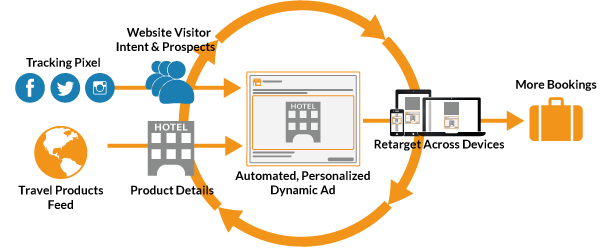
If a traveller surfs booking.com for a hotel booking in a target city, he/she will receive ads on all connected social media platforms associated with his google accounts on deals arising for that place to create a greater chance for them do book
(Jallouli et al., 2019)
E-tourism is a win-win deal of consumers and suppliers. The data exhaust of tourist/travellers’ preferences can be a great way to influence consumers choices of destinations, hotels, sightseeing, attractions and entertainment (Jallouli et al., 2019). In this way, as an entrepreneur, E-tourism acts as an eyeopener on different services and a way to invent new services/products and markets which falls directly into the aims of innovation in tourism.
Ads from OTAs are not always targeted towards consumer preferences, they sometimes provide the consumer with suggestions based on likes, click, comments, and even random search categories. In this way, it helps suppliers to widen their target market and promote their products and services to an expanded range.
(Jallouli et al., 2019)
The Future Role of Travel Agents
The E-tourism revolution identified above highlights a major problem for the travel agency sector in its current shape and form. E-mediaries, such as Microsoft’s Expedia in the USA, which rose from a newcomer to one of the top US travel agencies in four years (Buhalis 2003), have grown phenomenally due to the impact of Information Communication Technologies and new forms of intermediary and distribution electronically on the conventional high-street travel agent (Page & Connell, 2014).
Buhalis (2003) has suggest that the successful future travel agency will take less of a booking-office role and more of a travel management and adviser role, while adding value not accessible from online booking (2014).

References
50 Years Timeline – 1990 to 1999. (2020). Retrieved 13 February 2020, from https://www.visitbritain.org/50-years-timeline-1990-1999
Jallouli, R., Bach Tobji, M., Bélisle, D., Mellouli, S., Abdallah, F., & Osman, I. (2019). Digital Economy. Emerging Technologies and Business Innovation (pp. p29-39). Cham: Springer International Publishing.
Knopwood, A. (2019). 4 Amazing Design Ideas to Transform Your Travel Agency – Ezine Blog. Retrieved 13 February 2020, from http://www.ezineblog.org/2019/07/29/4-amazing-design-ideas-to-transform-your-travel-agency/
Magnitude, M. (2019). US Digital Marketing vs. Traditional Marketing | Marketing Magnitude. Retrieved 13 February 2020, from https://marketingmagnitude.com/us-digital-marketing-vs-traditional-marketing/
Page, S., & Connell, J. (2014). Tourism. Andover, UK: South-Western Cengage Learning.
RÙSLAND, K. (2016). New: Dynamic Ads for Travel – Increase Conversion and Lower Costs | StitcherAds. Retrieved 13 February 2020, from https://stitcherads.com/blog/new-dynamic-ads-travel-increase-conversion-lower-costs/
VIDAL, B. (2019). The New Technology and Travel Revolution. Retrieved 13 February 2020, from https://www.wearemarketing.com/blog/tourism-and-technology-how-tech-is-revolutionizing-travel.html
Zakkas, S. (2012). Online Travel Ecosystem – iNFOGRAPHiCs MANiA. Retrieved 13 February 2020, from https://infographicsmania.com/online-travel-ecosystem/
 Mengmeng's Blog
Hi Mengmengll,
I enjoyed this read and like how you took us on a journey of the travel agent’s evolution. I am interested to know if you think the same would apply for corporate travel? Whereby businesses may be looking to secure higher-end hotels, business class seats, and private transport arrangements for their employees? Do you think a booking site would be able to provide the same top-of-the-line booking service and deals as a travel manager with connections and affiliations with certain hotels for example?
Additionally, in terms of more complex journeys with layovers, for example, it has been suggested that sites like ‘Skyscanner’ are notorious for hiding layovers until the booking screen (Travelport Locomote, n.d.), and are not equipt to deal with issues such as cancellations, delays, accommodation difficulties. Thus for corporate travel at least do you think it is preferable to remain using an authentic, knowledgable and resourceful travel management company as opposed to an app?
Travelport Locomote (n.d.) ‘5 Reasons Business Travellers Do it Themselves’. Retrieved February 18, 2020, from https://blog.locomote.com/5-reasons-business-travellers-do-it-themselves
LikeLike
Hello Mengmeng, your article inspired me a lot. Tourism, as one of the earliest industries adopting digital technology, has been affected by it in many ways. The digital form represented by tourism websites is developing rapidly, and visitbritain.com is a good example. The author also introduces the digital business ecosystem and integration of systems. The article lists many examples of new technologies. It gave me a deeper and more comprehensive understanding of the way business and tourism are combined.
Online travel agencies are a new attempt and the development trend of modern tourism. However, I think traditional travel agencies also have irreplaceable functions, for example, deep tour and business travel suggested by another comment. If you want a more personalized travel experience and a deeper understanding of the destination culture, traditional travel agencies can provide more targeted plans and services.
LikeLike
Hey Mengmengll,
As a travel enthusiast, I have experienced profoundly the great changes brought about by travel in the digital economy era. As mentioned in your article, these various travel websites, apps for booking hotels, tickets, car rentals, and travel agencies with new service models have greatly facilitated our travel and reduced our travel costs. These are the benefits of digital.
But regarding E-Tourism, I don’t quite agree with it. Although the current AR and VR technologies continue to mature, travel itself is a process of contacting nature and new cultures and new people. This is the fun of travel. If you say Travel without leaving the house, then I feel that it is meaningless.
I think the development trend in the future should be to use AI and big data analysis to help people get better travel plans and experience a better world.
LikeLike