Hi everyone, this is Mengmeng, an MSc International Tourism Management student. I am from China and completed my bachelor study of Management Information System in the Beedie School of Business in Canada before I came to the UK.
I choose this module because I am a fan of digital technologies, and I believe it will bring a whole new experience for me by learning how the digital business model works.
This is the first post on my new blog. I’m just getting this new blog going, so stay tuned for more. Subscribe below to get notified when I post new updates.
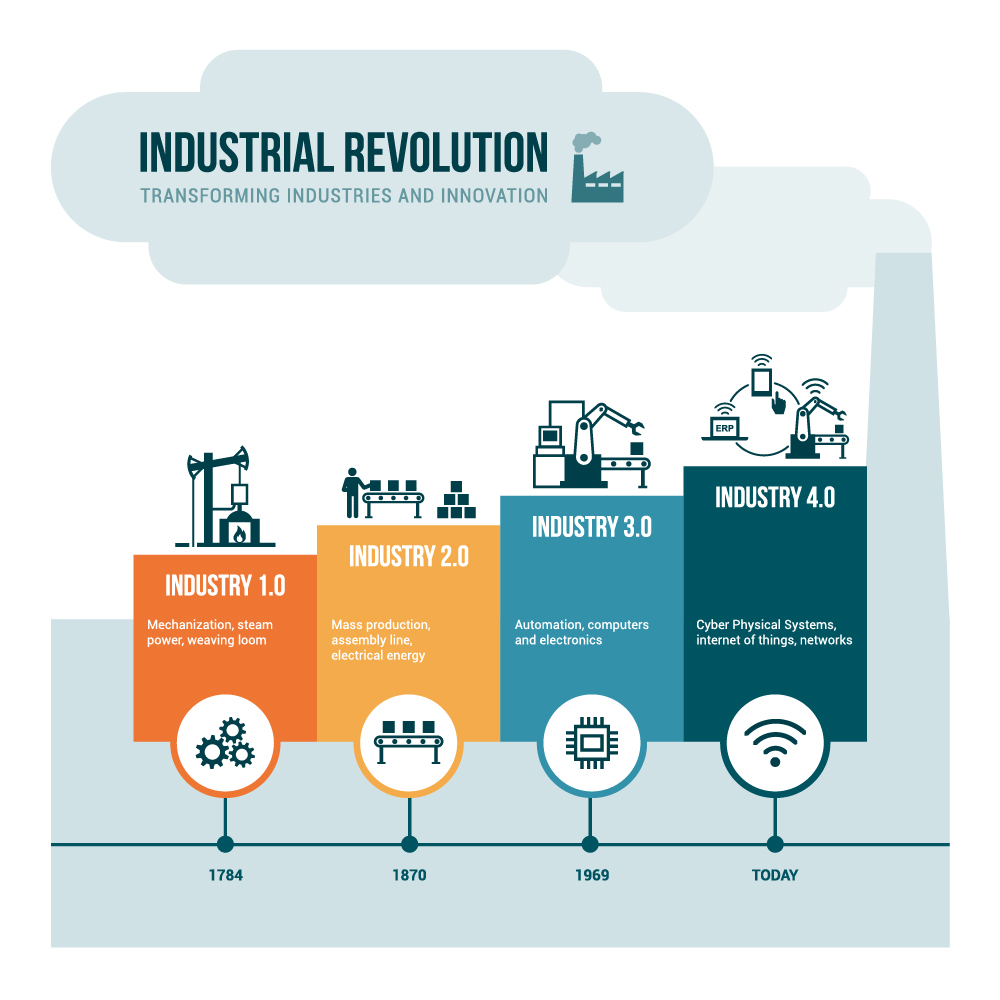
From the module Digital Business Models, we have been through a lot of interesting topics weekly. In the beginning, we’ve been talking about disruptive innovation, from the printing press to the 4th industrial revolution, including Artificial Intelligence, 3D printing, Internet of Things (IOTs), and Social Machines.
The emerging of digital technologies revealed the changing nature of work, which causes the need for re-skilling, relocation, and flexibility on a scale and forming the digital economy such as the rise of ‘digital nomad’ and ‘gig economy’. From the report of Cognizant (2017) that describing the characteristics of 21 new job roles, “coaching, caring, connecting” are the three themes identified. All of these roles involve significant human input, even if the technology is central to their function.
Do You Know the 21 Jobs of the Future Driven By AI? | Cognizant
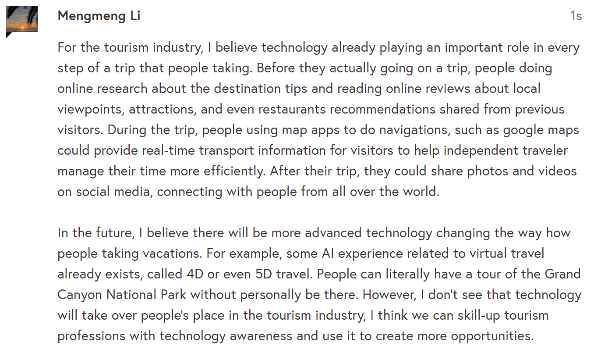
Among these topics I was specifically participated in the discussion in week 3 MOOC course, related to the changing time, changing roles; the IOTs; and the changing nature of work.
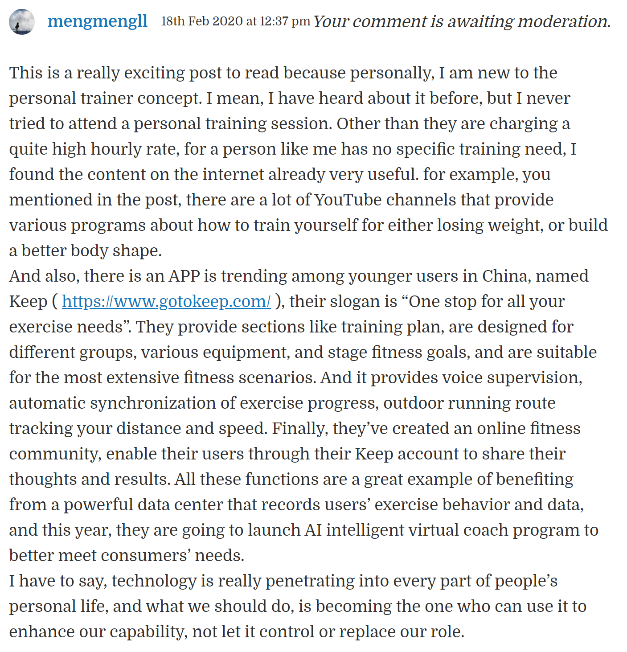
These lead to the first post about the job roles that changed by the digital economy, or about to change. I looked into details of the tourism industry, and find out the impact of online travel agency cause to traditional high street travel agents. And from reading several posts of other students, I found the change of personal trainer posted by claudia0601 and checkout assistant posted by liamvinson are specifically interested in me. Thus, I shared my personal experience of the exercise app and questioned the feasibility of tech-enabled stores.
After that, we continue to follow the steps of digital economies. For existing traditional businesses to be future-ready, digital transformation is unavoidable progress. There are multiple barriers to change, such as creativity limitation, cultural mindset, and satisfaction of the status quo. To overcome these challenges, according to Jim Hemerling (2016) of the Boston Consulting Group, there are five strategic imperatives to emphasize the need to put people first.
5 ways to lead in an era of constant change | Jim Hemerling
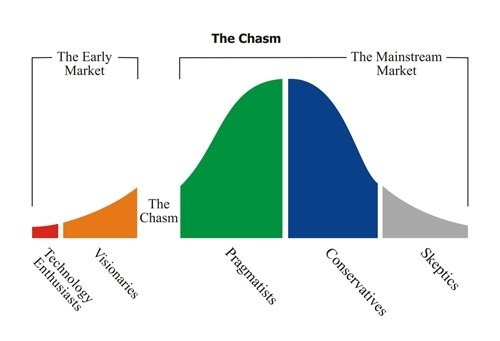
For innovation startups, there tends to be a tempting prospect yet with greater risk. Thus, usually, they would go through the process of venture capital funding seeking investors for support. To grow, they also need to consider the technology adoption lifecycle to successfully crossing “the chasm” (1990).
After looking into details of the circular economy and sharing economy, it brings us to the different digital business models that contribute to successful businesses. My subject was Expedia.com an online travel agency, and I found Bird Scooters, posted by liamvision, and HelloFresh, posted by pjjr201, are quite interesting cases, and I shared my personal experience and thoughts, shown as below.
Expedia, founded in 1996, is one of the world’s leading full-service online travel brands now, by helping travellers easily plan and book travel from the widest selection of vacation packages, flights, hotels, rental cars, rail, cruises, activities, attractions, and services (“Expedia | Expedia Group”, 2020). It is one of the brands from Expedia Group.
Expedia Group Technology Stories
Expedia value proposition: “You can book everything in one place—if something goes wrong, we can solve your problem in one place.” – Mark Okerstrom, president and CEO of Expedia Group
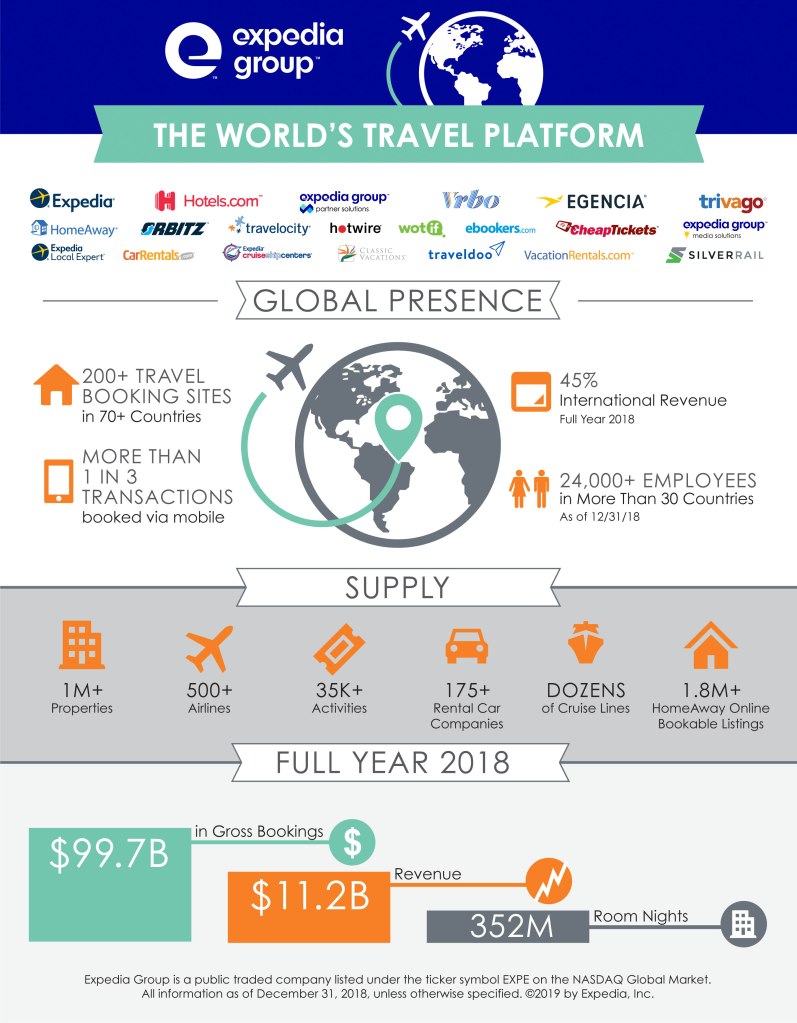
Expedia Group reported total revenues of $11.2 billion in 2018, its revenue has grown at a CAGR (compound annual growth rate) of 19% since 2016. It reported a gross booking of $99 billion (the total dollar value of transactions through agency and merchant bookings, which includes air tickets and other categories). Room bookings remain the key service category for Expedia Group as compared to other services such as air tickets and rental cars. It reported room nights of 352 million in 2018.
There are three general ways how Expedia Group generate revenues (Team, 2019):
Merchant Revenues: These are commissions received from the customer for travel-related transactions, where the company receives booking payments from the customer.
In 2018, merchant revenues for Expedia Group contributed 53% of total revenues, which is the main way the company doing their business.
Agency Revenues: These are commissions received from the service provider for travel-related transactions, where the company does not receive booking payments from the customer.
Agency revenues contributed 27% of total revenues in 2018 to Expedia Group
Advertising Revenues: These are revenues earned from referrals, advertising placements, and subscription fees.
The company received Advertising Revenues of around $1 billion in 2018.
As a large travel site, the brand Expedia.com gets its users from search, social, referrals, direct type-ins and paid channels. Expedia tailors its user experience for visitors coming in from each of these channels to maintain its conversion rate. Conversion rate optimization(CRO) is a major concern for a business as large as Expedia’s, and it does a great job of CRO best practices and innovations (Shaihob, 2016).
“When you’re dealing with tens of millions of transactions every year, even a 0.2% bump in conversion rates can translate into millions in extra revenue.”
For example, Expedia promotes its blog on its Twitter handle instead of the main website, which is promoted on the company’s Facebook page for different target audience segments. It also promotes its other social channels such as Snapchat through pinned tweets and custom logos.
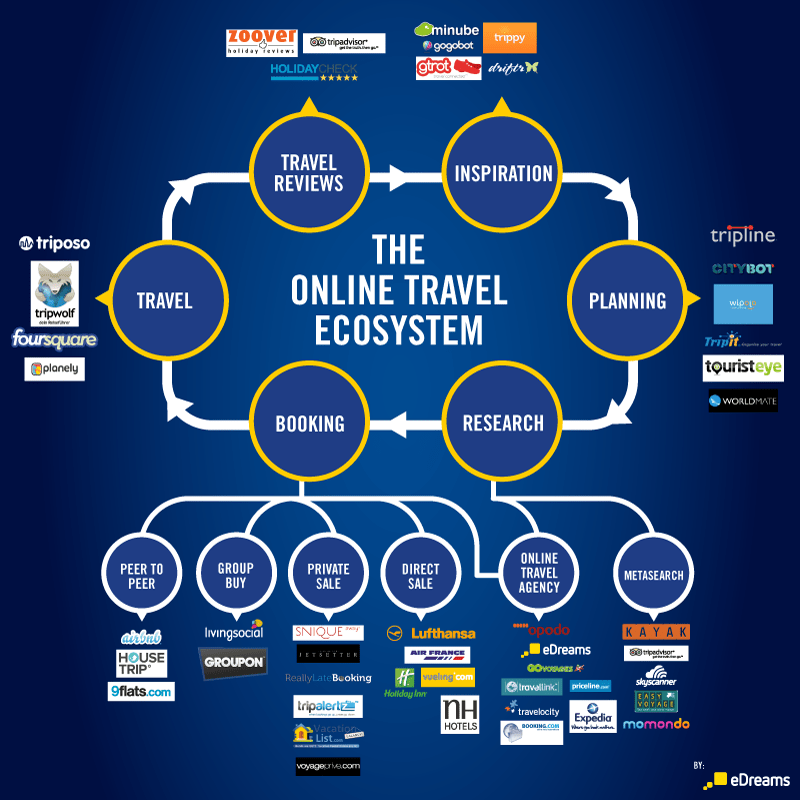
As a Marketplace of digital business model, Expedia working as an intermediate in between the service suppliers their customers.
Through the company’s “direct connect” technology, the proprietary supplier-oriented technology that streamline the interaction between some of their websites and hotel central reservation systems, making it easier and more cost-effective for hotels to management reservations made through Expedia brands.
“An important component of the success of our business depends on our ability to maintain our existing, as well as build new, relationship with travel suppliers and GDS partners (global distribution system)”.
To attract customers, Expedia differentiate their brand from their competitors primarily based on quality and breadth of travel products, channel features and usability, price, traveller service and quality of travel planning content and advice. From a product view, here are three main reasons why Expedia would be successfully sold to its customer: useful, easy to use, and trustworthy (Yu, 2015).
Useful
At the beginning of its launch, back in the late 1900s, as an online travel agency (OTA) it enables customers to discover and compare prices for travel at the click of a mouse. Imagine the old times, people have to go through the tedious process of calling up their travel agent and asking about pricing information for various travel permutations. By now, due to the great partner relationship of its suppliers, Expedia could provide an inventory coverage over one million bookable properties and over 500 bookable airlines.
Easy to use
Easy to discover travel options with widgets, filters, easy to understand text descriptions, rating snapshots, map views, and informative messaging such as “did you know you can cancel most reservations within 24 hours free of charge?”.
“Recommended“, powered by sophisticated algorithms that take data collected from previous uses and gleans insight on what may be relevant to the next traveller;
“Scratchpad“, save a user’s searches into their history, make their search easy to stay organized, update the change of price since their last search;
“Autocomplete“, provides 1-click Facebook login; efficient checkout process with various payment options accepted;
Timely email confirmation, as soon as the transaction finished, there would be a timely email confirmation with itineraries sent to customers inbox, which can be seen as a rewarding booking experience.
Trustworthy
Expedia provide 24/7 customer support, to defence in addressing customer frustration. As an indirect service provider, they always make sure they communicate with their suppliers get accurate information, so there are no surprises as misdescription with any products they provide. There is a review system that collects reviews only from verified hotel guests, which helps shoppers with a credible lens to evaluate the hotel. In addition, the real-time reviews creating data loops that will in the long run improve data accuracy on Expedia and set expectations for customers on par with what they will actually experience.
Further Technology Investment
The Rise of Mobile
Expedia’s mobile apps, offer compelling advantages to its customers in the area of price, convenience, ease of travel (Yu, 2015).
Steep discounts on same-day hotel bookings for the last-minute, on-the-go traveler who is looking for a hotel that night and does not have access to a desktop computer, but would be able to book a hotel via his mobile device.
Convenience
No need to print out itineraries
No need to search through one’s inbox to find itineraries
All seat in the app
Ease of travel
Push notifications to give travelers reminders when their flight is departing
updates on any gate changes or plane delays.
“We’re focused on machine learning algorithms and creating consumer behaviour models that identify patterns. That allows us to know when to present the right set of options in the right context and at the most meaningful time.” – Gabriel Garcia, Global Head of Mobile Marketing & App Ecosystems at Expedia
With the aim of easing the booking process for its users, Expedia is currently working on incorporating AI technology into is online travel business. The integration of AI technology could enable users to book or cancel flights and hotel reservations with voice commands on Alphabet’s Google Assistant from any device. Also, users will be able to access information about their Expedia trip itineraries as well as packing lists for upcoming trips with a simple voice command (“Online travel demand spells further success for Expedia”, 2019).
Above all, Expedia becoming a successful online travel agency due to its huge investment and forward thinking of technology application. As a digital platform, its impact to the traditional travel agency is huge. However, rather seeing Expedia as an competitor, it would be more constructive and create more opportunities with the collaborate between online and offline businesses in the travel industry.
Industry 4.0 is the term used to capture a number of trends occuring in the manufacturing sector driven by digitalisation, including automation, increased interconnectivity between cyber and physical systems, and increased management efficiencies provided by big data analytics and cloud computing (Dredge et al., 2018; Smit et al., 2016).
Tourism, which exhibits characteristic of both industry and service sector, is undergoing massive transformation as a result of advances in information technologies and processes of digitalisation.
Technology Development in Tourism
There are three key phases of technology development can be identified in tourism (Dredge et al., 2018).
Phase 1: Sales and marketing
1990-2000: destinations and business able to use Internet as marketing tool, in this way, Websites began to replace paper-based marketing materials.
Web-based reservation systems started to facilitate business transactions, and distribution systems facilitated increased coordination across the industry.
In 1996, British Tourism Authority launched its new website, visitbritain.com, and plans are made to tailor the site to local markets in the USA, Asia, and Europe.
2000-2010, the Internet becoming the key source of information for travellers, and it is acting as a virtual marketplace, allows products and services could be searched, compared, and transacted.
Visitor experience becoming more important than simply provide products by suppliers.
Customising products and personal connections with customers are key to suppliers.
New business model: innovative online intermediaries, Expedia vs. traditional travel agency
Review sites: TripAdvisor, empower customers as controller of their purchase and as influencer for future consumer
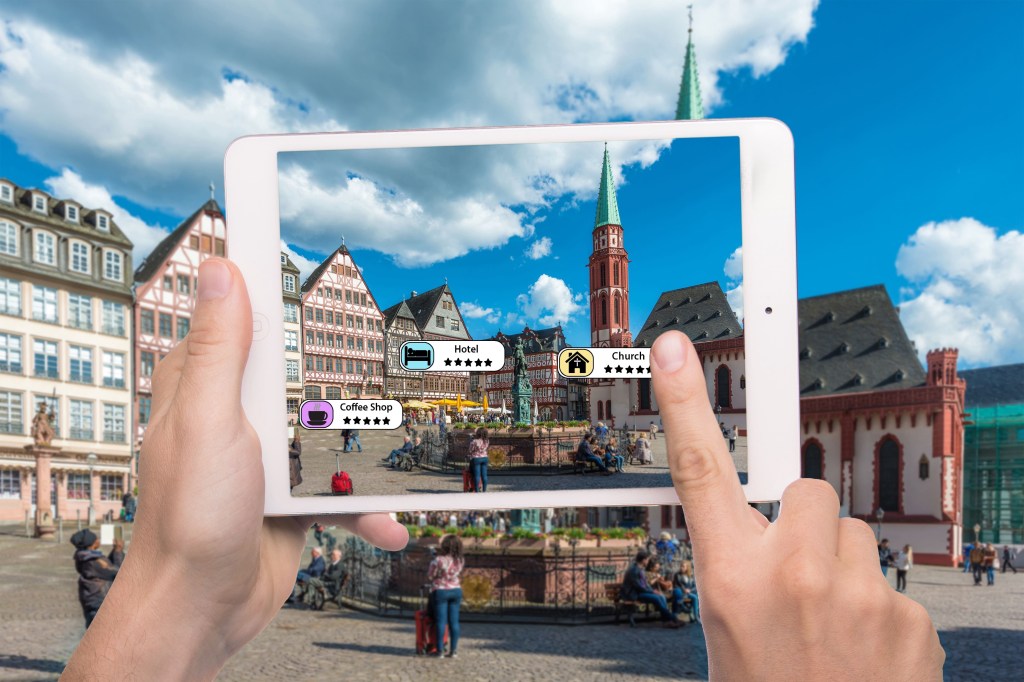
2010- , advances such as cloud computing, mobile and wearable technologies, augmented and virtual reality, GPS, and increased integration and interoperability of digital systems have facilitated interconnective between digital and physical worlds.
Today, it’s possible to “teleport” ourselves to the most remote corners of the globe without getting off the couch. That’s what you can get using Everest’s EVEREST VR app, which lets you see the top of the world without having to climb to the top.
The service industry as Tourism is one of the early adopters of digitalization which included airlines, travel agencies and hotels. There is a new sector created as the result of digitization in Tourism Industry named: Electronic tourism (E-Tourism), means all tourism services using a single platform (Jallouli et al., 2019).
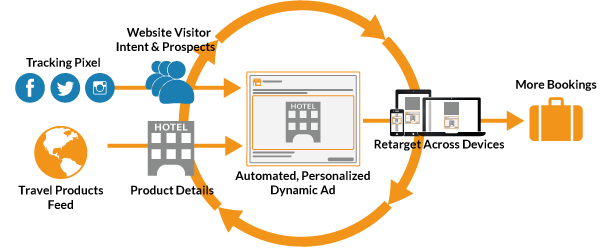
E-Tourism represented by online travel agents (OTAs) are a perfect example of customers empowerment. Through OTAs, tourists could gain access to a wider based discounted, tailored, and up to date travel information. Also, mobile integration has aided the move of tourism into the digital age. Smartphone users could use travel apps to plan their trips, and they could track air fares, hotel bookings, price comparison, availability with automatic notifications delivered to their phone. Social media platforms could be used by gathering consumer’s data to pop-up tailored ads based on customers’ preferences of travel.
Airbnb, supply its uses with apartments that can be rented and cheaper than hotels;
Skyscanner, provides its uses with a matrix of what are the cheapest air fares, hotels, and car rental agencies during a period of time.
(Jallouli et al., 2019)
OTA’s are major entrepreneurs in the tourism history. Their innovation in tourism covers plenty of areas, such as tourism destination, tourism products, technology, processes, organizations and business models, skills, architecture, services, tools and/or practices for management, marketing, communication, operation, quality assurance and pricing.
Data Matters
Today is the Era of data, the internet of things, artificial intelligence, and data analysis. E-tourism through OTAs and service providers platforms, have gained access to a wider consumer database, and they speak social platforms’ language. From customers number of clicks, previous transactions, demographics, travel preferences, service providers could tailor their products base on customers’ needs.
If a traveller surfs booking.com for a hotel booking in a target city, he/she will receive ads on all connected social media platforms associated with his google accounts on deals arising for that place to create a greater chance for them do book
(Jallouli et al., 2019)
E-tourism is a win-win deal of consumers and suppliers. The data exhaust of tourist/travellers’ preferences can be a great way to influence consumers choices of destinations, hotels, sightseeing, attractions and entertainment (Jallouli et al., 2019). In this way, as an entrepreneur, E-tourism acts as an eyeopener on different services and a way to invent new services/products and markets which falls directly into the aims of innovation in tourism.
Ads from OTAs are not always targeted towards consumer preferences, they sometimes provide the consumer with suggestions based on likes, click, comments, and even random search categories. In this way, it helps suppliers to widen their target market and promote their products and services to an expanded range.
(Jallouli et al., 2019)
The Future Role of Travel Agents
The E-tourism revolution identified above highlights a major problem for the travel agency sector in its current shape and form. E-mediaries, such as Microsoft’s Expedia in the USA, which rose from a newcomer to one of the top US travel agencies in four years (Buhalis 2003), have grown phenomenally due to the impact of Information Communication Technologies and new forms of intermediary and distribution electronically on the conventional high-street travel agent (Page & Connell, 2014).
Buhalis (2003) has suggest that the successful future travel agency will take less of a booking-office role and more of a travel management and adviser role, while adding value not accessible from online booking (2014).
Jallouli, R., Bach Tobji, M., Bélisle, D., Mellouli, S., Abdallah, F., & Osman, I. (2019). Digital Economy. Emerging Technologies and Business Innovation (pp. p29-39). Cham: Springer International Publishing.
This is an example post, originally published as part of Blogging University. Enroll in one of our ten programs, and start your blog right.
You’re going to publish a post today. Don’t worry about how your blog looks. Don’t worry if you haven’t given it a name yet, or you’re feeling overwhelmed. Just click the “New Post” button, and tell us why you’re here.
Why do this?
Because it gives new readers context. What are you about? Why should they read your blog?
Because it will help you focus you own ideas about your blog and what you’d like to do with it.
The post can be short or long, a personal intro to your life or a bloggy mission statement, a manifesto for the future or a simple outline of your the types of things you hope to publish.
To help you get started, here are a few questions:
Why are you blogging publicly, rather than keeping a personal journal?
What topics do you think you’ll write about?
Who would you love to connect with via your blog?
If you blog successfully throughout the next year, what would you hope to have accomplished?
You’re not locked into any of this; one of the wonderful things about blogs is how they constantly evolve as we learn, grow, and interact with one another — but it’s good to know where and why you started, and articulating your goals may just give you a few other post ideas.
Can’t think how to get started? Just write the first thing that pops into your head. Anne Lamott, author of a book on writing we love, says that you need to give yourself permission to write a “crappy first draft”. Anne makes a great point — just start writing, and worry about editing it later.
When you’re ready to publish, give your post three to five tags that describe your blog’s focus — writing, photography, fiction, parenting, food, cars, movies, sports, whatever. These tags will help others who care about your topics find you in the Reader. Make sure one of the tags is “zerotohero,” so other new bloggers can find you, too.












 Mengmeng's Blog